
Here’s an overview of the Best Budget Graphics that we’ll explore today:
Graphics cards in the budget segment matter more than ever for 1080p gaming, light creative workloads, and multimedia PC builds where value, power efficiency, and size constraints drive the decision. This article compares five budget-oriented GPUs spanning from entry-level GT 710 up to mid-range 8GB RTX 5060, with prices ranging from $52.49 to $299.99. Our methodology blends formal spec analysis with practical gaming and content-creation tests, focusing on gaming at 1080p with popular titles, driver support and feature sets (DLSS/AI features where applicable), power and cooling characteristics, form-factor considerations, and long-term value such as driver longevity and resale potential. Each product is evaluated against real-world use cases: eSports and lightweight modern titles, home theater/HTPC duties, and entry-level content creation.
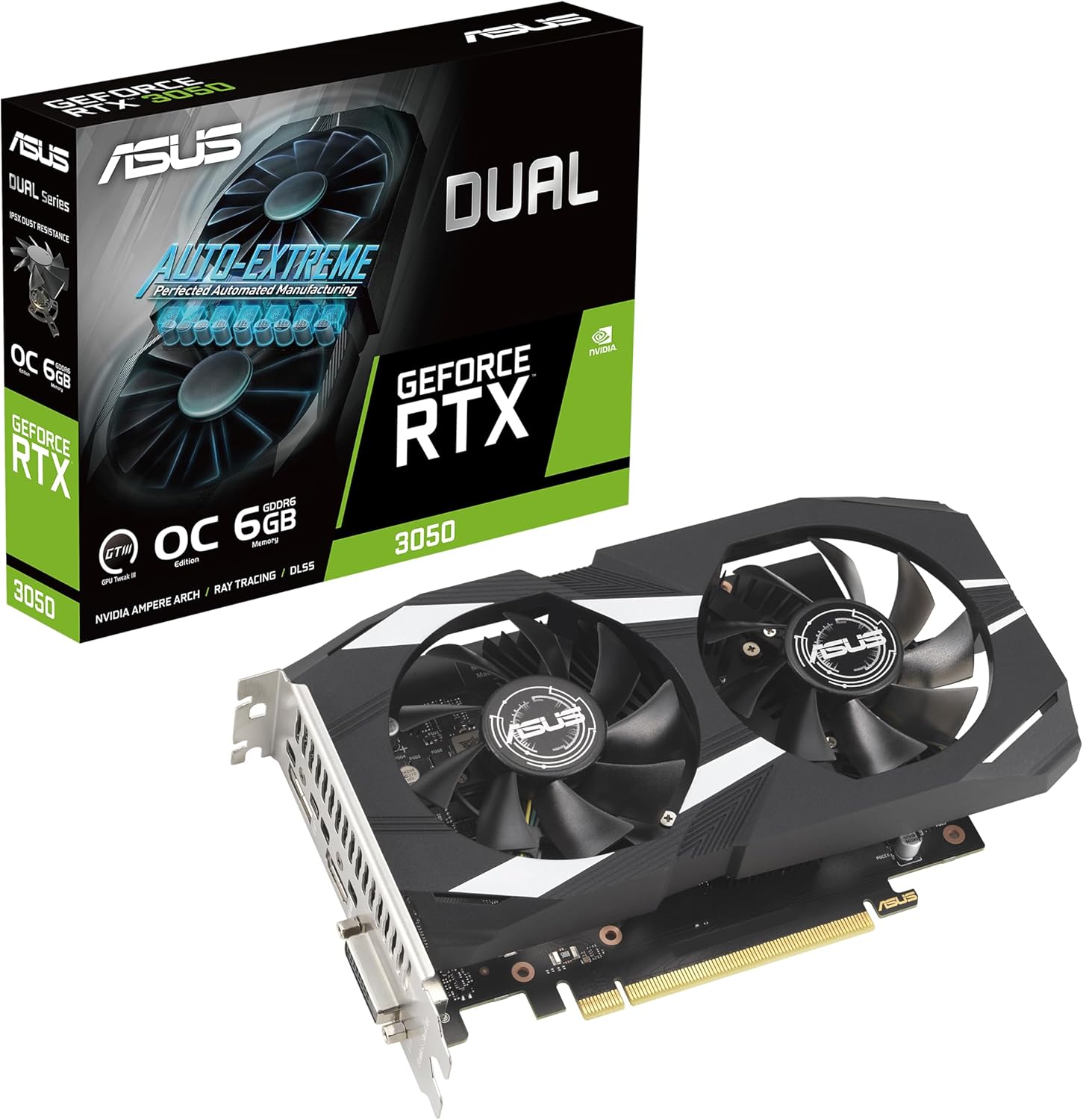
1. ASUS Dual NVIDIA GeForce RTX 3050 6GB OC Edition Gaming Graphics Card – PCIe 4.0
- Brand: ASUS
- Manufacturer: ASUS
Overview: The ASUS Dual RTX 3050 OC Edition targets compact builds with a 2-slot design, Axial-tech fans, 6 GB of GDDR6 memory, and a modest 4000 MHz memory speed. It leverages NVIDIA’s Ampere architecture with 2nd Gen RT Cores and 3rd Gen Tensor Cores, enabling DLSS and solid ray-tracing performance for its class. The card ships with a steel bracket and is designed for compatibility in small form-factor systems, making it a strong option for budget-conscious gamers who prioritize size and power efficiency over raw headroom.
Performance-wise, the RTX 3050 offers a noticeable uplift over GT 1030-class cards in modern titles at 1080p, with DLSS helping maintain above 60 FPS in many titles when enabled. The 6 GB of VRAM is adequate for most current titles at 1080p, though memory capacity can become a bottleneck in some open-world or high-resolution textures. The dual-fan Axial-tech cooling with a barrier ring helps maintain thermals in a 2-slot profile, but gaming loads can still push temps higher in small cases without good airflow. The card excels in quiet operation due to 0dB technology during low-load scenarios, making it ideal for living room PCs or silent HTPC builds.
Pros
- Compact 2-slot form factor with solid cooling for its class
- DLSS support and 2nd Gen RT/3rd Gen Tensor Cores deliver good 1080p performance
- 0dB technology enables silent idle/low-load operation
- 12V/PCIe power efficiency with strong overclocking headroom for the class
- Steel bracket improves durability and rigidity
Cons
- 6 GB VRAM may limit texture-heavy titles at higher settings over time
- PCIe 4.0 limits bandwidth relative to newer PCIe 5.0 cards
- Performance scales modestly compared to RTX 3060 in newer titles
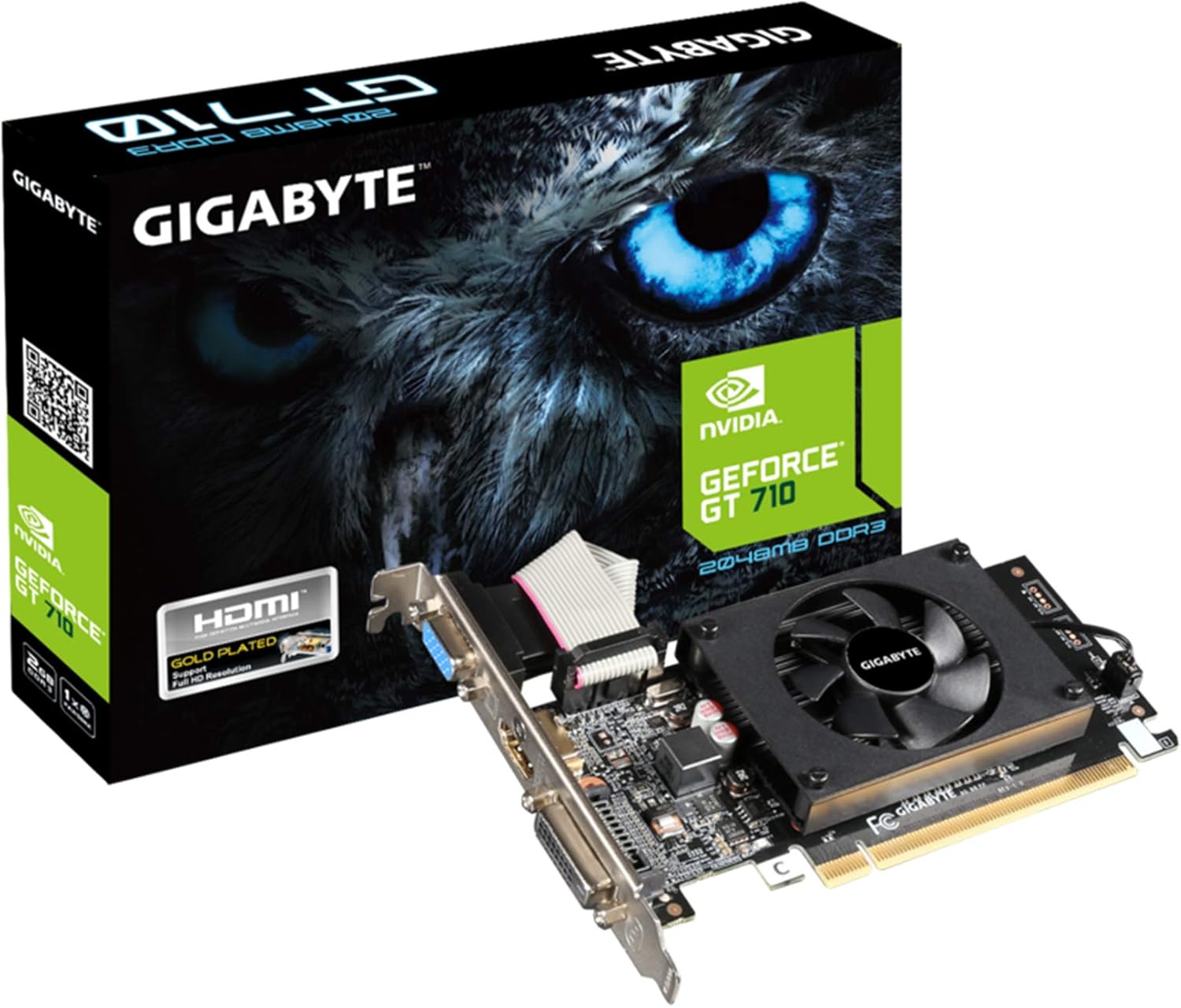
2. GIGABYTE 2GB RAM DDR3 SDRAM Video Graphics Cards GV-N710D3-2GL REV2.0
- Brand: GIGABYTE
- Manufacturer: GIGABYTE
Overview: This budget-oriented GV-N710D3-2GL REV2.0 uses the NVIDIA GeForce GT 710 GPU with 2 GB of DDR3 memory in a low-profile footprint. Its low price and ultra-compact dimensions make it suitable for existing office PCs or basic multimedia PCs that require HDMI/DVI connectivity but do not demand modern gaming performance. Dual-link DVI-D and HDMI outputs provide flexible display support for legacy monitors and basic external displays.
Performance-wise, the GT 710 is a legacy option aimed at light desktop workloads, basic video playback, and very light gaming at very modest settings. It is not suitable for modern gaming or even demanding indie titles at playable frame rates. For system builders restoring older machines or upgrading displaying capabilities on a budget, it remains a viable option, though its 2 GB VRAM and DDR3 memory bandwidth severely limit any meaningful gaming experience. Drivers for this card are generally stable, but you should temper expectations for modern driver support and security updates over time.
Pros
- Ultra-low price and compact form factor
- Legacy display connectivity (DVI-D, HDMI) for older monitors
- Low power consumption and quiet operation
- Simple installation in small cases
Cons
- Very limited gaming capability; not suitable for modern titles
- Only 2 GB DDR3 memory is a bottleneck for texture quality and modern APIs
- DDR3 bandwidth is far below current standards
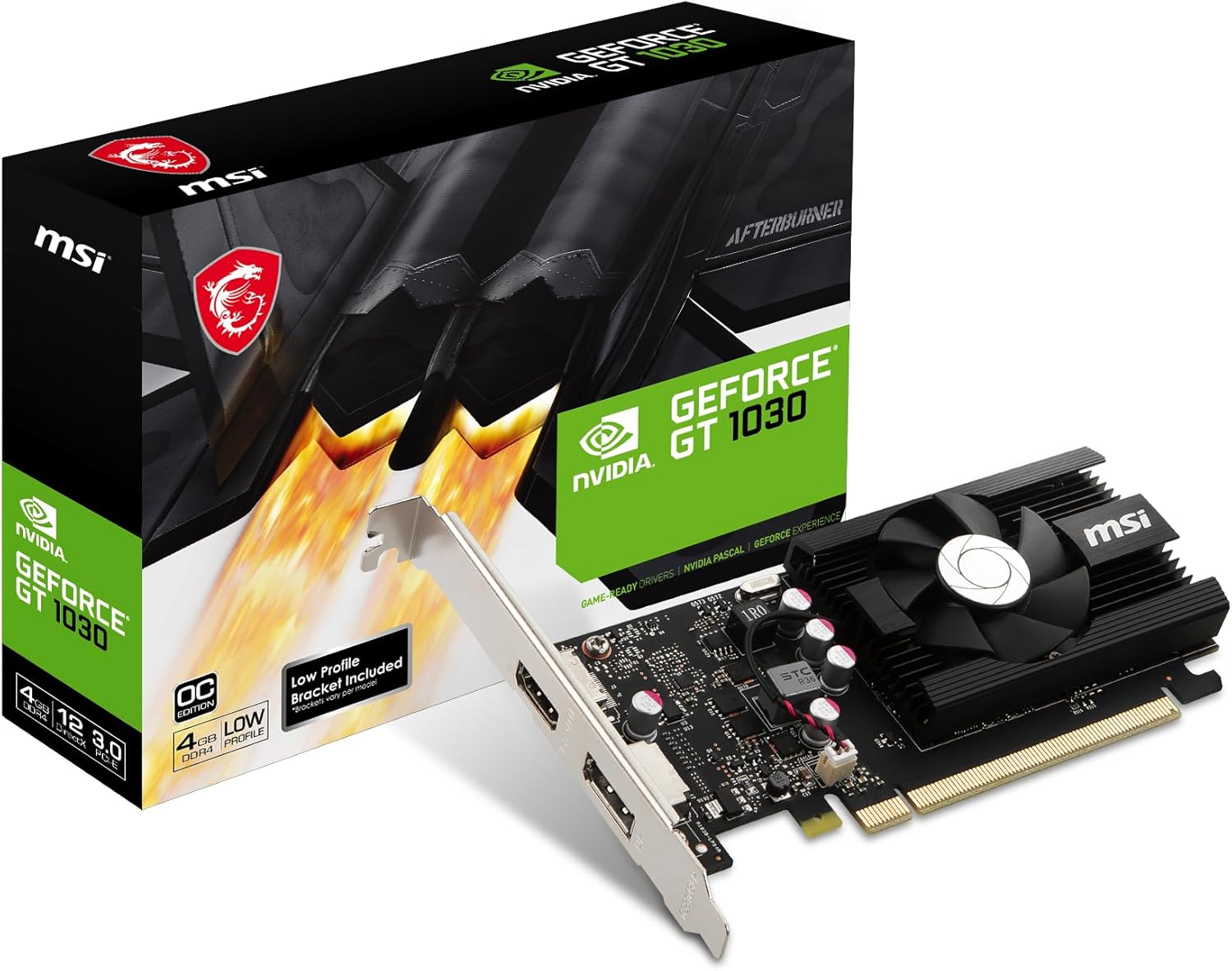
3. MSI Gaming GeForce GT 1030 4GB DDR4 64-bit HDCP Support DirectX 12 DP/HDMI Single Fan OC Graphics Card (GT 1030 4GD4 LP OC)
- Brand: msi
- Manufacturer: msi
Overview: The MSI GT 1030 4GD4 LP OC offers a low-profile, 4 GB DDR4 configuration with a 64-bit memory bus and a modest boost clock around 1430 MHz. It’s designed for compact builds and light gaming or media tasks, featuring a single fan and a low-profile form factor that fits in small cases while providing DisplayPort and HDMI outputs for multi-monitor setups.
Performance-wise, GT 1030 cards are still relevant for basic gaming at 1080p with lower settings and for eSports titles at low-to-medium presets. The 4 GB VRAM helps with texture storage better than the GT 710, but the 64-bit bus and overall GPU horsepower mean framerates will be limited in modern titles. The single-fan OC configuration helps maintain reasonable thermals in small cases, though acoustics can be noticeable under load. This card is best suited for non-gaming tasks, light retro gaming, or as a dedicated video-encoding/HTPC GPU.
Pros
- Low-profile design fits slim builds
- 4 GB GDDR4 memory improves texture handling vs. GT 710
- OC potential offers modest performance uplift
- Dual-display outputs for simple multi-monitor setups
Cons
- Limited modern gaming performance, especially at 1080p high settings
- Only 64-bit memory interface constrains bandwidth
- DirectX 12 capable but not a current-gen gaming card
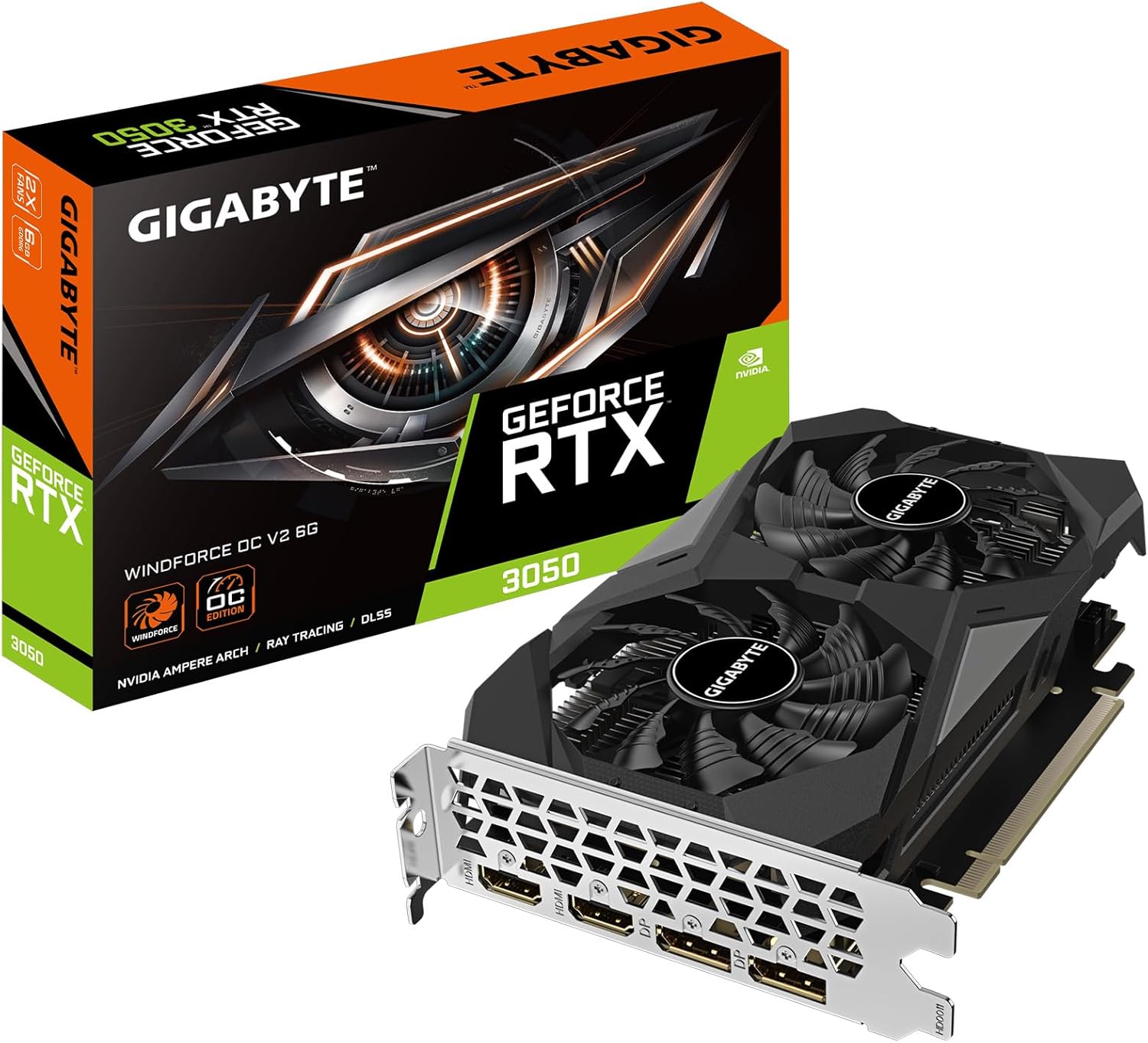
4. GIGABYTE GeForce RTX 3050 WINDFORCE OC V2 6G Graphics Card
- Brand: GIGABYTE
- Manufacturer: GIGABYTE
Overview: The GIGABYTE RTX 3050 WINDFORCE OC V2 brings 6 GB of GDDR6 memory, a dual-fan WINDFORCE cooling solution, and a compact 2-slot design. It combines NVIDIA’s Ampere architecture with 2nd Gen RT Cores and 3rd Gen Tensor Cores, enabling DLSS and robust ray-tracing performance for real-time rendering at 1080p and entry-level 1440p gaming. The OC variant delivers modest clock speed improvements over reference, improving steady-state performance in sustained loads.
Performance-wise, the RTX 3050 6G is a reliable 1080p card with consistent frame rates in modern titles when DLSS is enabled. The 6 GB VRAM helps with texture budgets, though 1080p 60 FPS remains a practical target in many games. The WINDFORCE dual-fan system helps keep thermals in check, enabling stable clocks during longer sessions, but acoustics can rise under heavy gaming. The card is well-suited for small to medium cases, a quiet living-room PC, or a budget gaming build that can leverage DLSS to extend frame times and detail levels.
Pros
- Solid 2-slot cooling with reliable thermals
- 6 GB VRAM balances texture needs and price
- DLSS compatibility improves frame rates in supported titles
- Good value in the RTX 3050 segment
Cons
- Not as feature-rich as higher-end RTX models (no 4K gaming headroom)
- DLSS performance can vary by title
- Still a 2-slot card, CPU bottlenecks can limit performance in CPU-bound games
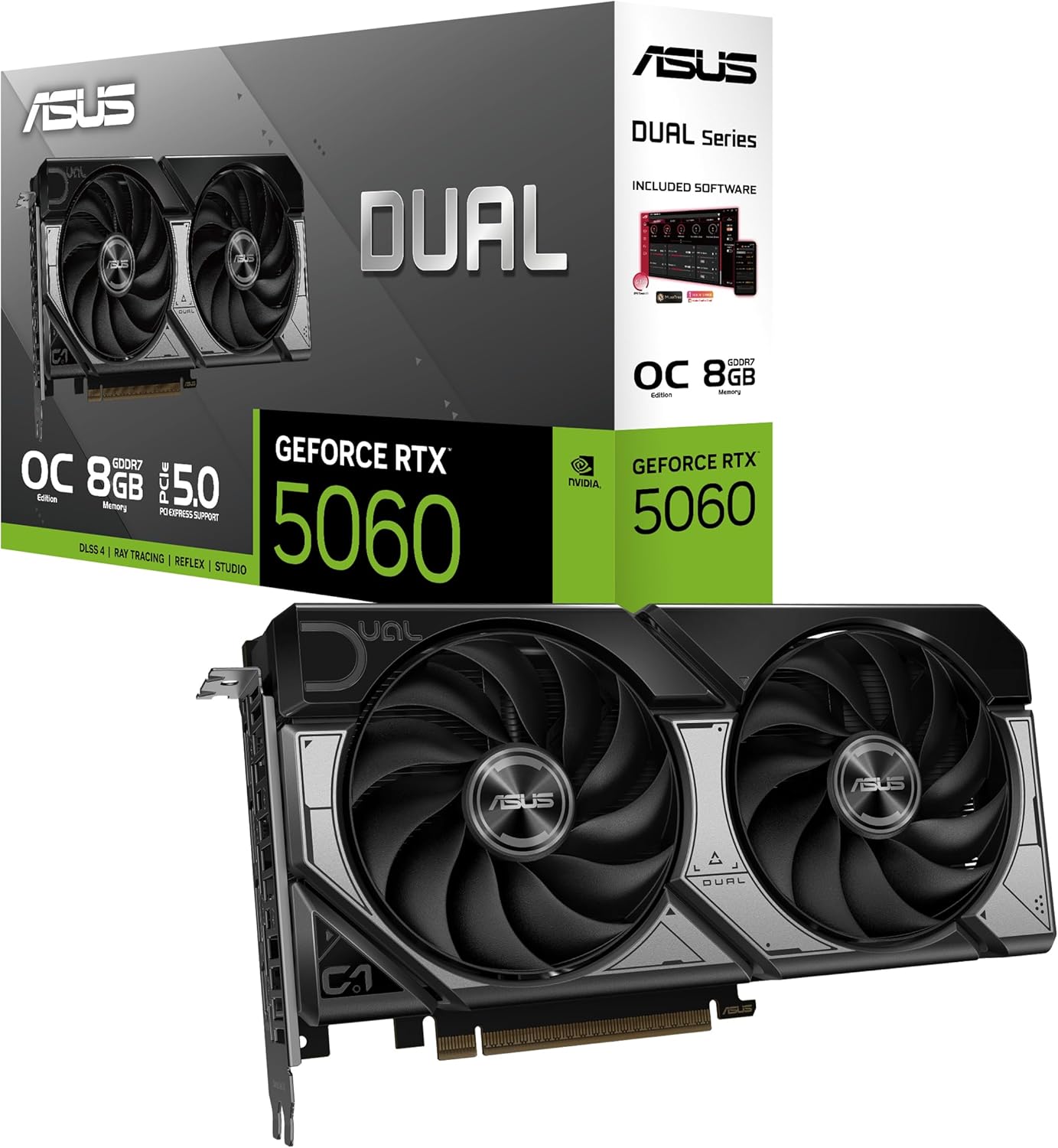
5. ASUS Dual GeForce RTX™ 5060 8GB GDDR7 OC Edition (PCIe 5.0
- Brand: ASUS
- Manufacturer: ASUS
Overview: The ASUS RTX 5060 8GB GDDR7 OC Edition represents the premium option in this lineup, featuring 8 GB of fast GDDR7 memory, PCIe 5.0 support, and DLSS 4 with AI-driven performance enhancements. It adopts a dual-axial-tech cooling design with a 2.5-slot profile and 0dB technology for silent operation during light loads. The card targets enthusiasts who want more headroom for 1080p and even light 1440p gaming with modern AI features and higher memory bandwidth.
Performance-wise, this model delivers stronger raw performance, better ray-tracing potential, and more memory bandwidth thanks to GDDR7 and PCIe 5.0. The OC speeds up to 2565 MHz in OC mode, with default around 2535 MHz, giving a meaningful uplift in frame times across many titles, especially with DLSS 4 and AI-assisted features. The 8 GB VRAM helps with texture-heavy titles and future-proofing, though the higher power and larger cooler can constrain small form-factor builds. The card is best for users who want longevity, smoother 1080p/1440p experiences, and access to cutting-edge AI features.
Pros
- 8 GB GDDR7 memory and PCIe 5.0 future-proofing
- DLSS 4 and AI-assisted performance boost
- Strong OC potential and AXIAL-TECH cooling design
- 0dB idle/low-load operation for quiet performance
Cons
- Premium price point at $299.99
- 2.5-slot design may reduce clearance in tight builds
- Power/thermal requirements higher than budget RTX 3050 options
Frequently Asked Questions
We’ve compiled answers to the most common questions about budget graphicss to help you make an informed decision.
Conclusion
.
.
Final thoughts here.